Case Study
In Subpart O, we look at Machinery and Machine Guarding. Almost all workplaces will have some machinery that moves and present a hazard. And new equipment is being introduced all the time. Sometimes, workers remove guards or alter the equipment to make it “easier†to use, or “more comfortable,†or to perform “faster.†OSHA finds these types of violations of easy targets.
Subpart P transitions along with machinery, and discusses guarding, but concerns itself with the types that are handheld and portable. These are probably the most abused tools in the workplace. Available for use by almost anyone, and often not inspected or stored correctly.
Subpart Q discusses the requirements for welding, cutting and brazing, and the different types of welding. Welding can be a hazardous occupation if improperly done — everything from fires, inhalation hazards and burns to the eyes. If you, or someone you know, has ever suffered a welding flash burn, it is pretty painful and severe.
Subpart R takes us into particular industries. Laundries, Sawmills, even Bakeries, in addition to Telecommunications and Electric Power Generation, Transmission and Distribution. Because these are specialized industries, they require specific regulations. Just looking at the Telecommunications standard alone is extremely involved.
Finally, Subpart S looks at electrical systems in the workplace. These are minimum requirements and reference other standards. It would be good to review the NFPA codes, in particular, NFPA 70e.
Instructions

WE WRITE PAPERS FOR STUDENTS
Tell us about your assignment and we will find the best writer for your project.
Write My Essay For MeThe standards in Subpart S are consistently in the top 10 in OSHA’s most frequently cited standards lists and highest penalties assessed lists. The standards in Subpart S are complex and often misunderstood—even by professional electricians.
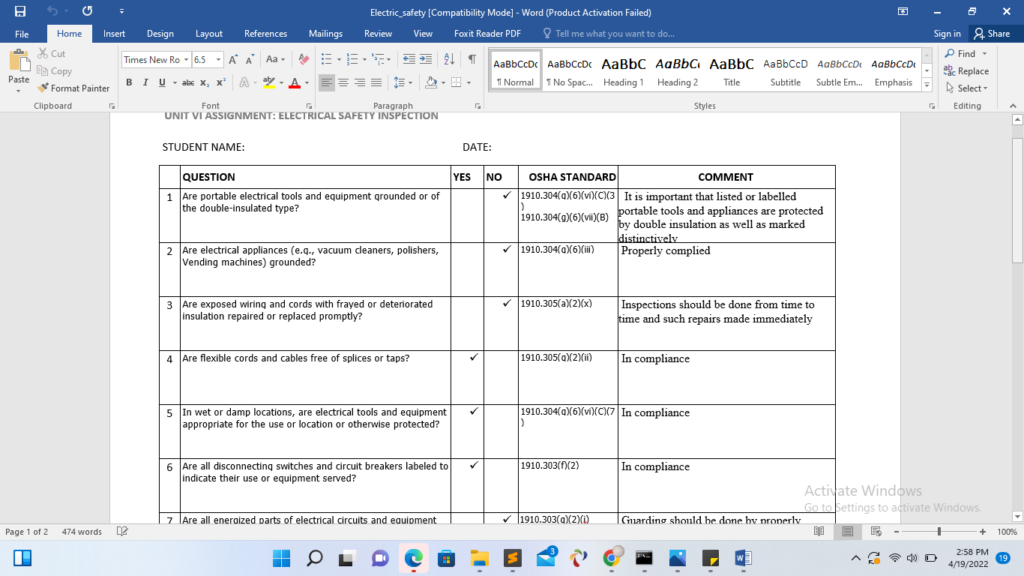
Use the checklist (see attached) to conduct an electrical safety inspection of your workplace. Add the citation for the OSHA standard for each question. In the comments section for each item, include your recommendations for correcting the violations. If a checklist item does not apply to your organization, explain why in the comments. In the summary section at the end of the checklist, discuss the significance of any noncompliance you found, and identify the types of injuries that might result if the violations are left uncorrected.
If you did not find any noncompliance, discuss what your organization does to prevent electrical safety violations and electrical injuries. Compile the checklist information into a report that outlines the major issues, if any, found in your workplace.
The case study should be two pages in length (double-spaced), including the completed checklist. The report must follow APA guidelines for formatting, and the report must include a title page and reference page.
SAMPLE SOLUTION

Order Original and Plagiarism-free Papers Written from Scratch: